
Guide: scale and water treatment
Hard Water, Scale and Your Ice Machine: What a Filter Can Fix
The repair technician said your ice machine is full of scale and that is why it keeps breaking down. Here is how hard water causes that damage, what the water data really says for Florida and the Gulf South, and which filter will help.
- How scale damages the machine
- Utility hardness numbers by city
- Filter, softener or reverse osmosis
- When to change the cartridge
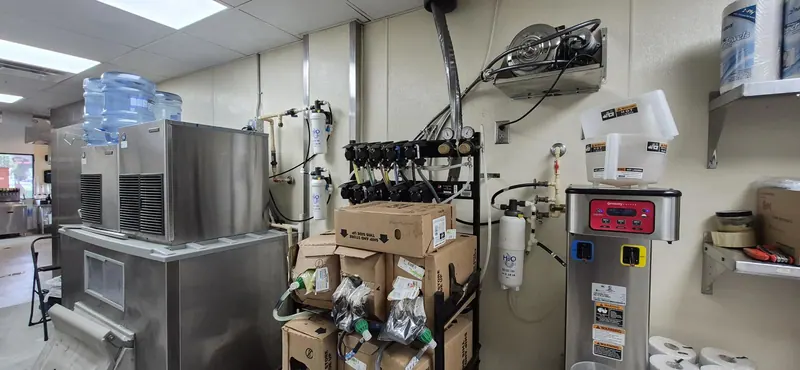
The short answer
Hard water leaves mineral scale on an ice machine's evaporator, valves and water passages, which slows production and causes breakdowns. Florida hardness depends on the source: Orlando's utility reports 129 ppm, while Pensacola's utility publishes no hardness figure. Test your water, then choose a scale-control filter, softener or reverse osmosis system to match.
Scale is a common reason an ice machine slows down, makes cloudy or thin ice, or needs repairs it should not need. A Manitowoc manual says local water conditions may require treating the water to inhibit scale formation and filter sediment.
The catch is that "Florida water is hard" is only partly true, and it depends a lot on which utility and which aquifer your water comes from. This guide uses each utility's own reports for local numbers, and it notes where no number exists.
How does hard water damage a commercial ice machine?
Hard water damages a commercial ice machine by leaving calcium and magnesium scale on the evaporator, water distributor, pump, valves and sensors. Scale acts like insulation, so each freeze cycle runs longer. Scale also clogs small water passages and makes moving parts stick, which leads to thin ice, failed harvests and more service calls.
Ice machines concentrate minerals. As water freezes on the evaporator, the pure water turns to ice first and the minerals stay behind in the water that is left. That is why scale builds up faster in an ice machine than in a faucet on the same line.
Where scale does the most harm:
| Part | What scale does |
|---|---|
| Evaporator | Slows freezing, causes uneven or partial cubes, makes harvest harder |
| Distributor and spray holes | Blocks water flow over the evaporator |
| Water pump | Adds wear and can seize the impeller |
| Inlet valve and float or sensor | Sticks, causing overfill, underfill or shutdowns |
| Water trough | Builds crust that also holds slime |
Descaling with the manufacturer's cleaner removes scale that is already there. Water treatment slows how fast it comes back.
How hard is the water in Florida?
Florida water hardness depends on the source. A USGS study of the upper Floridan aquifer found water under 180 ppm in the northwest and much of central Florida, and over 180 ppm, up to 1,900 ppm, across most of the rest of the state. Orlando Utilities Commission reports an average of 129 ppm for Orlando water.
Two cautions about that USGS data. It is from 1965, revised in 1975, and it describes untreated aquifer water, not what any utility delivers today. For your building, the utility's own report is the better number.
The USGS scale: under 60 ppm is soft, 60 to 120 ppm is moderately hard, 120 to 180 ppm is hard, and over 180 ppm is very hard.
| Area | What the utility reports | What it means for an ice machine |
|---|---|---|
| Orlando, FL (OUC) | Average hardness 129 ppm, or 7 grains per gallon, from the Lower Floridan Aquifer | Hard on the USGS scale. Plan for scale control. |
| Pensacola, FL (ECUA) | Water from 28 wells in the Sand-and-Gravel Aquifer, treated with lime for pH and phosphoric acid for corrosion control. No hardness figure published. | Unknown from the report. Test the water at the machine. |
| Birmingham, AL (BWWB) | Total hardness 40 to 156 mg/L in 2024 data (mg/L reads the same as ppm) | Ranges from soft to hard. Test at your site. |
Note that ECUA's wells draw from the Sand-and-Gravel Aquifer, not the Floridan, so the USGS Floridan numbers say nothing about Pensacola tap water. Other cities around Orlando use other utilities, so check your own bill for the utility name and read its annual water quality report.
What kind of water filter stops scale in an ice machine?
A scale-inhibiting ice machine filter is the usual first step to control scale in a commercial ice machine. It typically combines sediment filtration, carbon and a scale inhibitor in one system. Very hard water or high dissolved solids may call for a softener or reverse osmosis instead. Choose from a water test and the machine maker's guidance.
Each type of treatment does a different job:
| Treatment | What it does | What it does not do |
|---|---|---|
| Sediment prefilter | Catches sand, silt and rust | Nothing for hardness or taste |
| Carbon | Reduces chlorine taste and odor | Does not remove hardness |
| Scale inhibitor | Slows scale from forming on machine parts | Does not remove hardness minerals from the water |
| Water softener | Swaps hardness minerals for sodium | Leaves total dissolved solids about the same |
| Reverse osmosis | Removes most dissolved minerals | Needs a drain, storage and correct sizing |
Two practical points. First, ask which treatment your ice machine maker approves before installing a softener or reverse osmosis system on its supply. Second, size the filter to the machine. A cartridge too small for the machine's daily water use loads up fast and restricts flow.
We have installed twin and triple cartridge systems, water softeners and reverse osmosis units alongside commercial ice machines. The right setup depends on the water test and the machine. If a softener is the answer, see our softener pages for Pensacola, Birmingham and Orlando, each written around that city's own water report.
How often should an ice machine water filter be changed?
An ice machine water filter should be changed when it reaches the rated gallons or the rated months on its label, whichever comes first. Busy machines reach the gallon limit early. Change the cartridge sooner if water flow drops, scale returns quickly, or the filter sat in water during a boil water notice or storm.
A quick way to see how fast you use a cartridge: a gallon of water weighs about 8.3 pounds, so a machine making 500 pounds of ice a day uses at least 60 gallons of water a day for the ice alone, before any rinse water. Compare that to the gallon rating on the cartridge label.
Keep track by:
- Writing the install date on the housing or a service label.
- Logging the change with the ice machine's cleaning record.
- Checking at every cleaning, so filter and machine stay on the same schedule.
If you had a boil water notice or storm contamination, follow our boil water notice steps for ice machines for when the cartridge must be replaced.
Scale and filtration in the field
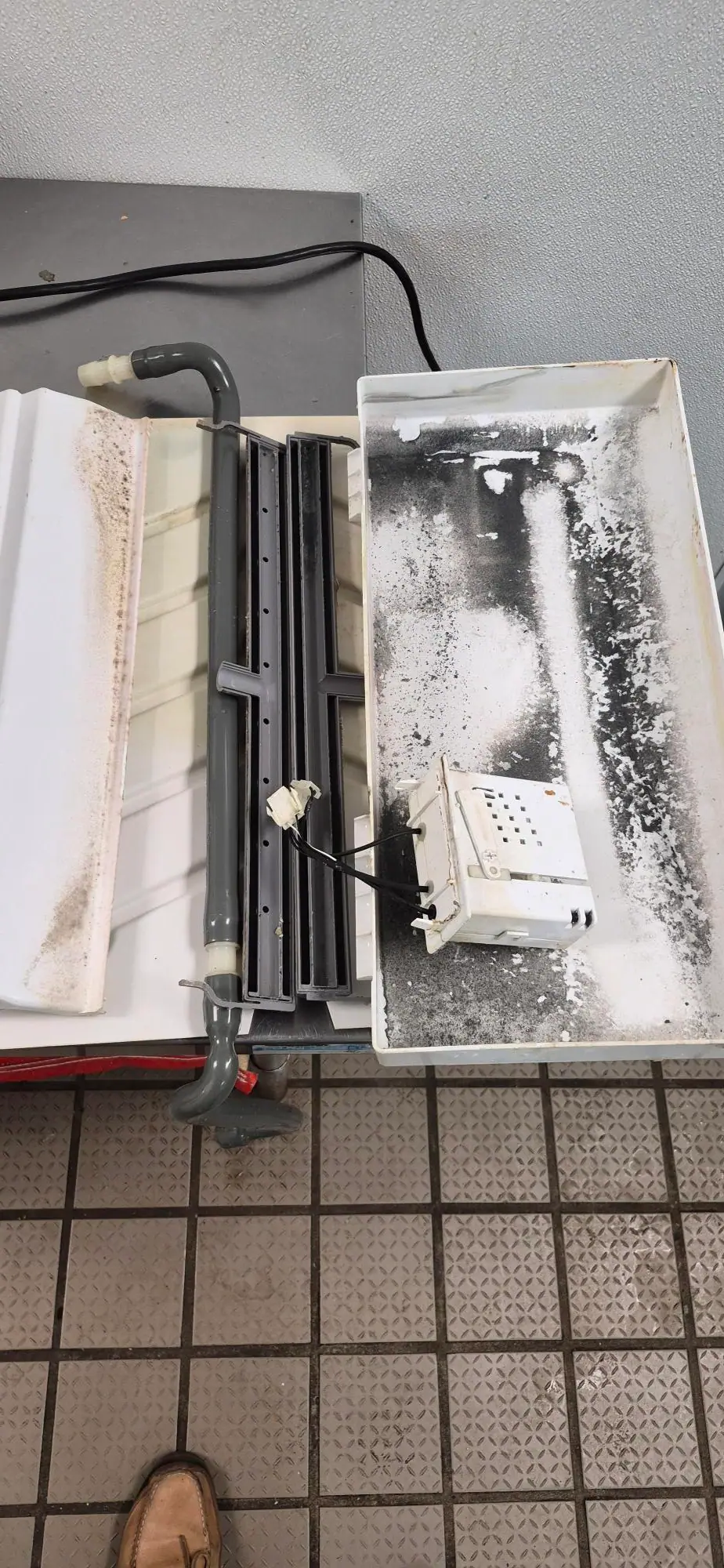
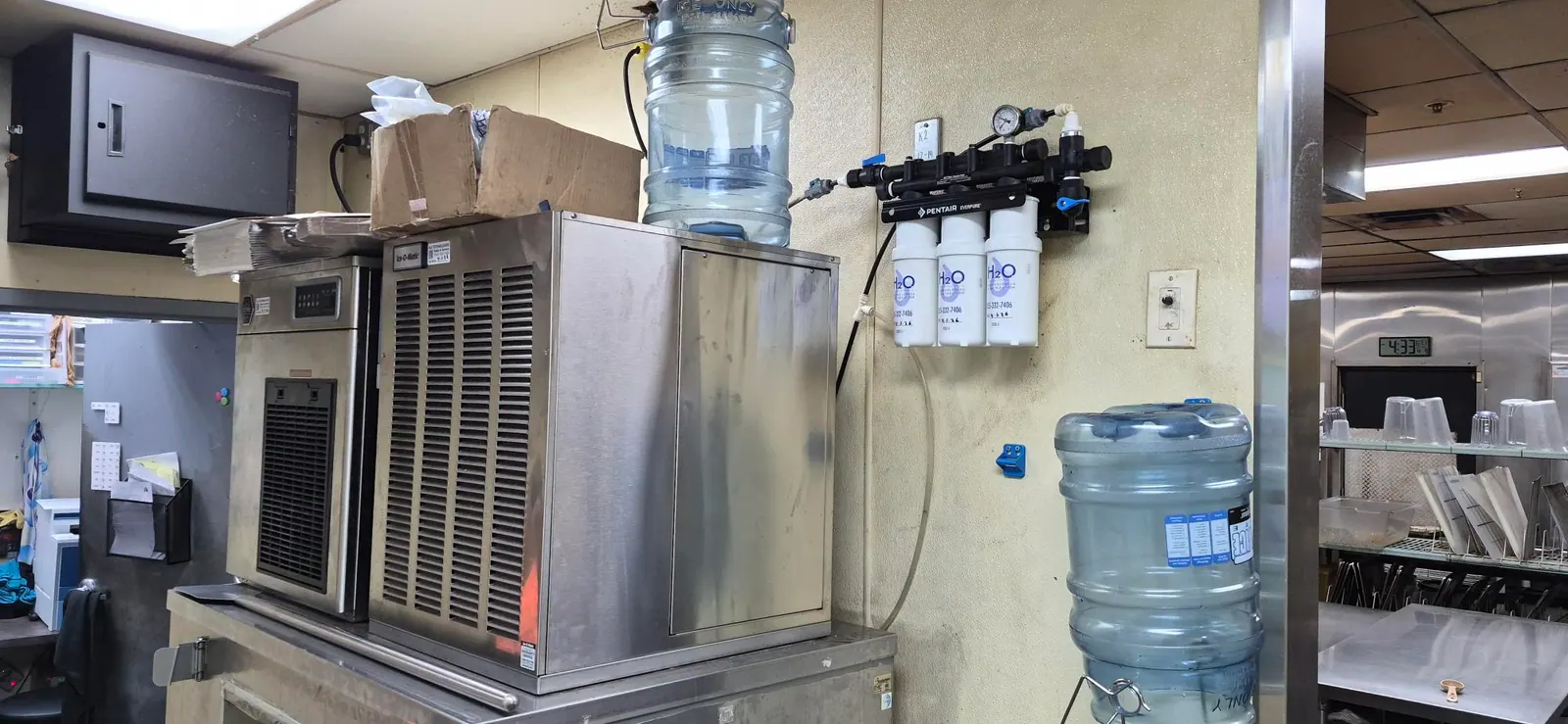
Scale removed during a cleaning, and a triple filter system installed to slow it from coming back.
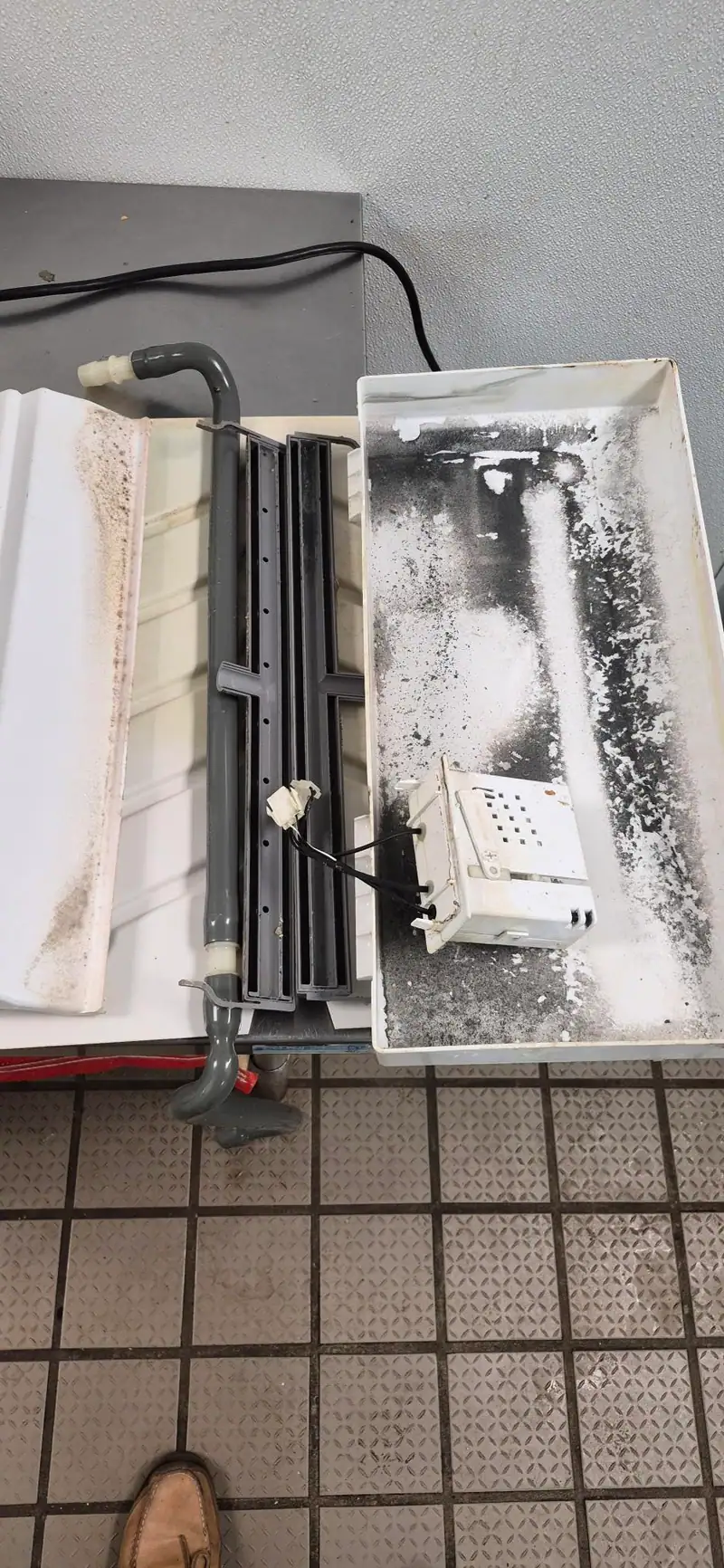 View larger photo
White scale on evaporator parts, Orlando, FL 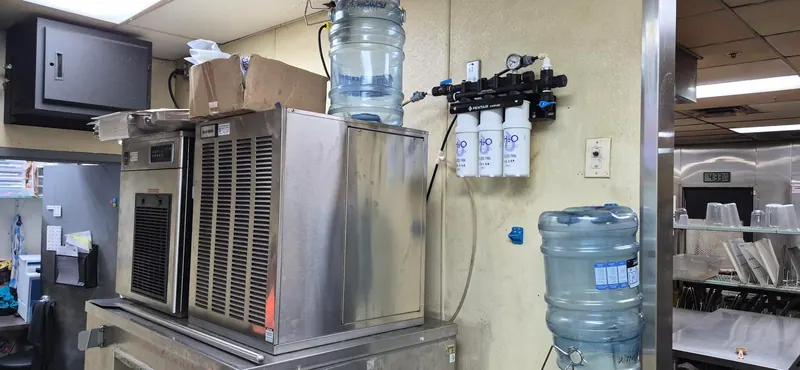 View larger photo
Ice machine with a triple filter system, Orlando, FL 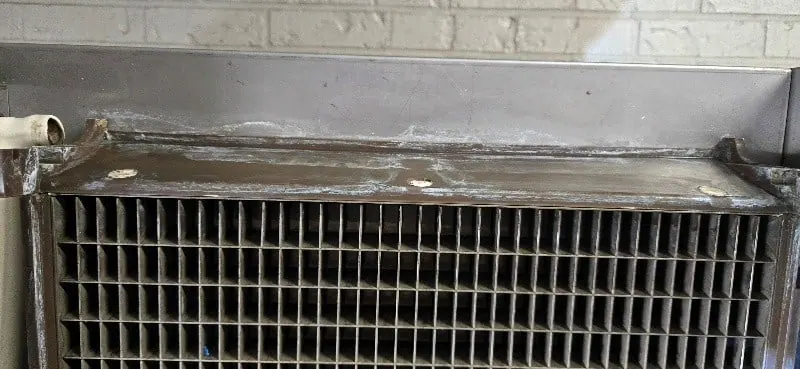 View larger photo
White mineral scale on top of an ice machine evaporator grid 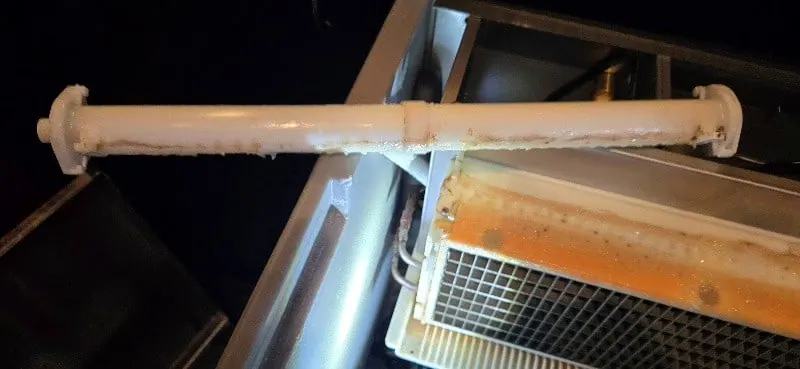 View larger photo
Scaled water distribution tube lifted above the ice machine evaporator
Hard water and ice machine questions
Is Pensacola water hard?
Will a water filter remove the scale already in my ice machine?
Is a water softener good for an ice machine?
Can you test our water and recommend a filter?
Sources
- USGS, Shampine, Hardness of Water from the Upper Part of the Floridan Aquifer in Florida, 1965, revised 1975, via Floripedia
- Orlando Utilities Commission, water services FAQ
- Emerald Coast Utilities Authority, 2025 Consumer Confidence Report
- Birmingham Water Works Board, 2025 Consumer Confidence Report
- Manitowoc QM20 Series installation, use and care, and service manual
Schedule a water check for your ice machine
Tell us your machine and your city. We will call you back to set up a water test and a filtration recommendation.
Call (850) 391-0460